By Daran Wu

Introduction
I've been wondering how to write about the Zeiss Otus 55mm F1.4 — not only because it's a manual lens with superb image quality, but because I fully integrated it into my professional wedding shoots, and it even influenced my shooting style. After nearly a year of use (2017–2018), here are my impressions from professional work.
Why a Standard Lens?
The 50mm standard lens has always been a focal length I rely on heavily. Across many assignments, 50mm has an indescribable quality — not too far, not too close; what the eye sees is what you shoot, rendering scenes with dimensionality and naturalness. For me that's wonderful — intuitive composition. And a prime's wide aperture creates obvious depth, performing well even in low light. I especially love 50mm standard lenses — out of that love, my dry cabinet holds more than five 50mm lenses (film and digital systems alike ^^").

What Drew Me In
When the Zeiss Otus 55mm F1.4 launched in 2012, it was hailed as "the best 50mm fast lens ever" — a brand-new optical design with near-perfect image quality, discussed across every website and forum. But such an outstanding lens came at a staggering US$4,000 price and manual-focus only, making it a hard choice to accept.

My main work system is Canon — 1Dx and 5D3. The Canon EF 50mm F1.2L is Canon's best native 50mm, but it's a decade-plus-old design; shooting wide open, purple fringing and aberrations are obvious, and detail loss has always troubled me, so I often compromised by stopping down for better quality. Even so, the Canon EF 50mm F1.2L remains a fine workhorse.
.
In late 2016, a wedding shoot drove home the wide-open quality gap, and I decided to invest in change. By chance, I decided to try the Zeiss Otus 55mm F1.4 — the legendary best 50mm standard lens.

Focusing in the Field
Before committing to the Zeiss Otus 55mm F1.4, manual focus was my biggest doubt — could it handle wedding work? Unlike AF lenses' short focus throws, the Zeiss Otus has a very long throw, enabling more precise focusing. Half-press the shutter, turn the focus ring gently until focus confirms, and shoot. Reviewing the work, the accurate-focus rate was far higher than I'd expected.
Of course, manual focus isn't as quick as autofocus — there's usually a longer lead time, typically one to three seconds. Some might think that's way too slow~ well~ true~ but it's also about method. Slow focusing forces you to slow your shooting rhythm, pressing the shutter carefully (because you can't rush…), and focusing more on "shooting" itself. I too thought it impossible for real work — but after the first use it didn't feel that hard, and with practice my keeper rate reached professional standards. Special mention: the Zeiss Otus focus ring is the smoothest of any lens I've used — no wrist strength needed, just a gentle finger nudge.

But what about moving subjects — can manual focus keep up? Hehe~ that's truly a test. Ordinary AF lenses are nearly impossible to focus manually because their throws are too short for precision. But the Zeiss Otus 55mm F1.4's very long throw means that once you match the subject's movement speed with your finger's turning speed, manual tracking isn't impossible.

Real Work — Bokeh
Early in my photography, honestly I couldn't clearly distinguish bokeh differences, reading others describe it online as "melting like butter" or "intoxicating swirly bokeh". Later I came to understand "bokeh" — it's the imaging result of a lens's whole chain of optical characteristics, tied to optical path design, focal length, aperture blade count, and glass material and precision.
.
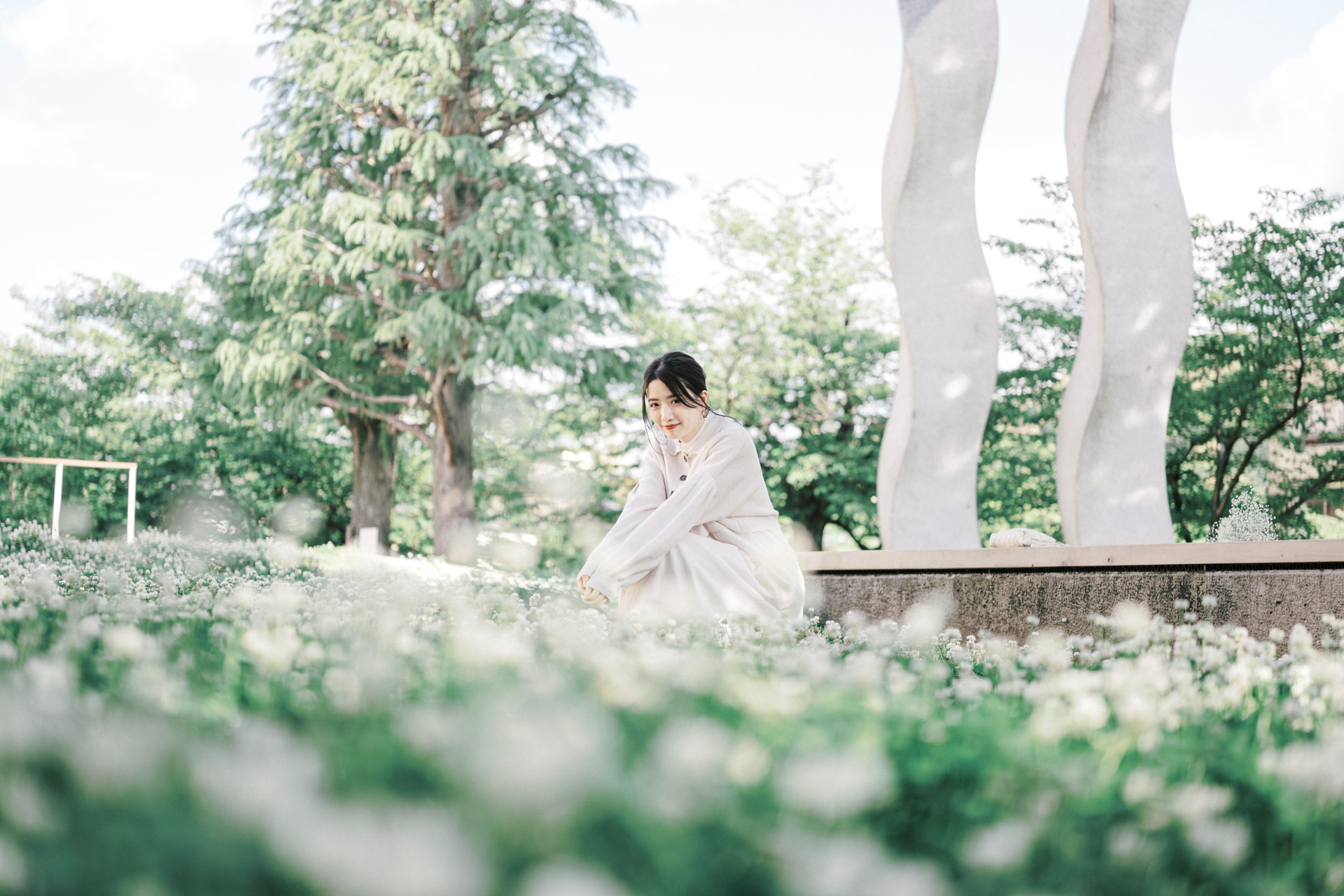
One thing Zeiss is known for is "dreamlike bokeh". When I move in close, background shapes — thanks to the wide aperture and closer shooting distance (key bokeh factors) — dissolve into clusters of soft color patches. This blur is gentle and beautiful; in-focus areas stay sharp and solid, with the transition between sharp and blurred perfectly natural — just right.
.
Put another way, modern lenses are all optically excellent — "character" becomes the key consideration. Zeiss's bokeh is absolutely its most captivating trait: a feeling, a sentiment. Once you learn to see it, you're in real trouble!


.
I also love shooting against single-color backgrounds — it directly expresses the bride's character, and through camera angle and focus design, this bokeh stays clean yet charming.
.

Real Work — Detail
I've used many top-tier fast L lenses and adapted Leica legends to my cameras — but the moment I mounted the Zeiss, I felt the difference right on the camera's screen. Same body, different imaging — utterly staggering. The Zeiss Otus 55mm F1.4 renders detail superbly, with aberrations and dispersion near-perfectly corrected, plus outstanding color rendition — giving images a bright, crystalline quality.

Size and Weight
This is definitely not a lens you carry out lightly — size and weight exceed ordinary fast primes. The metal-and-rubber styling feels modern; I wasn't used to it at first, but grew to like it — build quality and precision are excellent. I love the Otus 55mm F1.4's metal hood: black flocking inside reduces reflections, and the hood itself is thick, sturdy, and "impact-resistant" — it's survived several bumps and drops on real jobs, absorbing the force and keeping the lens intact. It's been through a lot, poor thing.

Conclusion
Pros:
. Outstanding color rendition
. Dreamy, warm, creamy bokeh
. Near-perfect aberration and dispersion control
. Excellent manual-focus experience
. Exquisite build quality
. Rugged metal hood
. Weather sealing
Cons:
. High price barrier
. Large size and weight
. Manual focus
As an image-quality-first lens, the Otus 55mm F1.4 pushes optical performance to the max regardless of cost — my real-world shooting proves it. It's an outstanding professional lens: with natural light you can shoot wide open with total confidence, rendering elegant, characterful bokeh and dimensionality; stop down a little for rock-solid detail.
.
Over this past year of switching to Zeiss manual lenses for wedding shoots, my photography unexpectedly changed. Perhaps because the rhythm slowed — manual focus made me more attentive, more careful before each press of the shutter. I find I capture the image in my mind more precisely, and my demands on detail improved because of that "slowness".
I never imagined a lens could change my photography. The Otus 55mm F1.4 is absolutely one of my best investments in recent years — but it takes time and patience to master. If you want speed and light weight, it's not your first choice: it sacrificed size purely to chase near-100-point image quality. I admire that craftsman spirit — because as photographers, we too chase the beautiful soul within the frame.
Some may ask — other lenses can do that too, right?~ To me, some lenses are just lenses, carrying specs. But some lenses have soul — unique, tasteful — and the Otus 55mm F1.4 is exactly that unique one.
Photographing with what you love — an indescribable joy~


Share this story