M12 Rumors · X2D II Firmware Lenses · ZEISS Cine Showcase
Camera Forest News · 2026.11.04
Camera Forest News
Rumors, firmware and cine lenses
Three stories today: the updated Leica M12 rumor list (same 60MP sensor, buttons move right, said to be in production), four unannounced lenses found inside the Hasselblad X2D II firmware, and ZEISS bringing three cine lens families to Camerimage for hands-on shooting. About 5 minutes to read.
M12 rumor update
Same 60MP sensor, buttons move right, said to be in production.
Four lenses in the firmware
A 65E f/1.7 and two unreported Mark IIs.
ZEISS cine lineup in full
Three new families open for hands-on comparison at Camerimage.
Leica M12 rumor update: same 60MP sensor, buttons move right, said to be in production
Rumor roundup, Leica Rumors (Nov 3, 2026), not officially confirmed
The rumor list for the next M camera has been updated. Leica Rumors reported on Nov 3 that the M12 will keep the M11’s 60MP sensor and processor, gain a larger rear screen and right-side buttons, and is reportedly already in production, with an announcement possibly in December or early 2027. None of this has been confirmed by Leica.

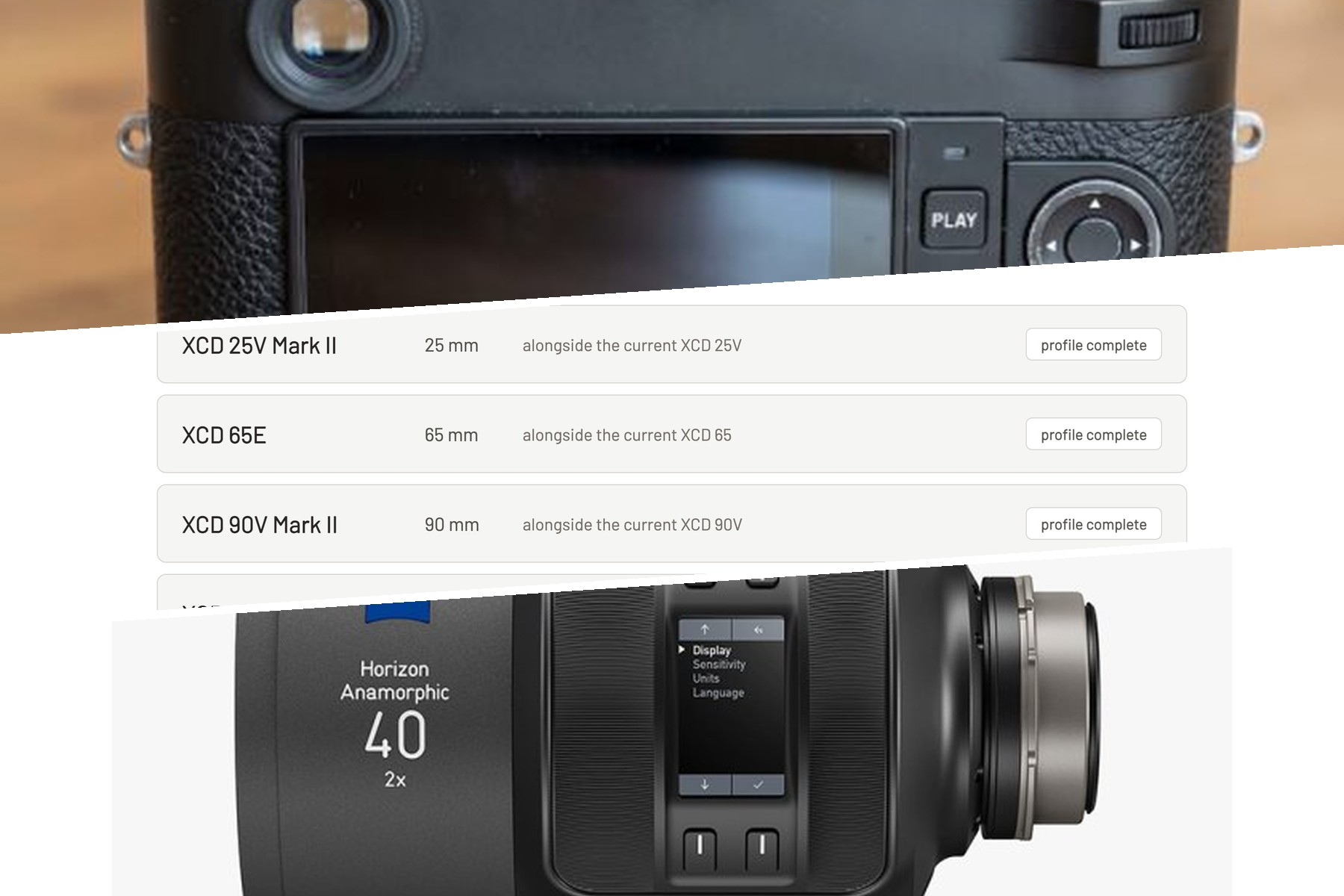
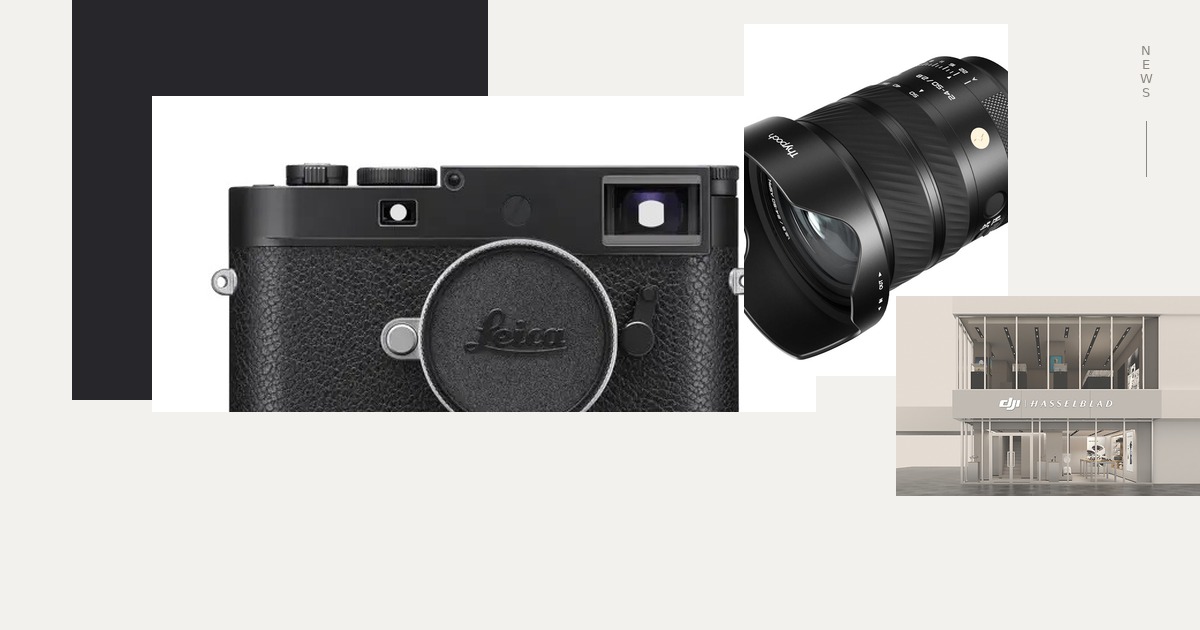
Image | Leica Rumors (rear-layout reference, not an official product photo)
Said to be the same as the M11, processor included
Rumored; camera said to be in production
What the list says
The imaging core carries over: the same 60MP sensor and processor engine as the M11, and the earlier rumored Chinese-made Gpixel sensor is not on this version of the list. Dynamic range is said to be better and color rendering different, with the source even wondering about an M9 CCD-style simulation. Also on the list: no IBIS, a new settings menu, and no base plate.
The back of the camera changes most
The screen grows, and the buttons move from the left of the rear panel to the right, in a layout similar to the SL3-P and Q3; the reference image shows PLAY, FN and MENU all on the right of the screen. M cameras have used their rear layout for years, so this is the change long-time users would feel first, and it is the most concrete item in the rumor.
Timing and confidence
The list says the M12 is already in production, with an official announcement rumored for December or early 2027. This is a rumor roundup, not an official statement, and both specs and timing can still change. If the production claim is true, though, the design is locked and the next few months of reports should only get more specific.
Highlights
Proven 60MP core carries over at low risk; rear layout aligns with the SL3-P and Q3; said to be in production, so the timeline has a shape.
Shortcomings
No IBIS, so handheld low-light shooting does not improve; same sensor generation, so the upgrade is modest; everything is still unconfirmed rumor.
Best for
M10 and M11 owners waiting on the next generation; rangefinder watchers; anyone planning an upgrade budget early.
Our take
The M12 upgrade is not about pixels. It is about controls.
The most notable part of this list is not a spec. It is Leica moving the M’s interface toward the SL and Q lines: buttons on the right, a bigger screen, a new menu. The imaging core stays with the proven 60MP unit, which keeps risk low; what changes is the logic of holding and operating the camera every day.
Stay calm about the rest: no IBIS and the same sensor make a weak upgrade case for M11 owners. The M12 looks more like a generation that tidies the M11’s foundation and paves the way for a future in-house sensor. Until Leica confirms anything, treat this as a direction, not a reason to sell the camera in your hand.
Four unannounced lenses hide in the X2D II firmware: a 65E f/1.7 and two Mark IIs
Industry news, Tonal Photo firmware analysis (Nov 2026), unofficial, not confirmed by Hasselblad
Someone has been reading the X2D II’s own firmware, and it names lenses Hasselblad has not announced. Tonal Photo decoded the lens-correction database inside firmware 1.3.18.1 and found four unannounced lenses: the XCD 65E f/1.7, 135V f/2.5, 25V Mark II and 90V Mark II. The two Mark IIs have not been reported anywhere else.
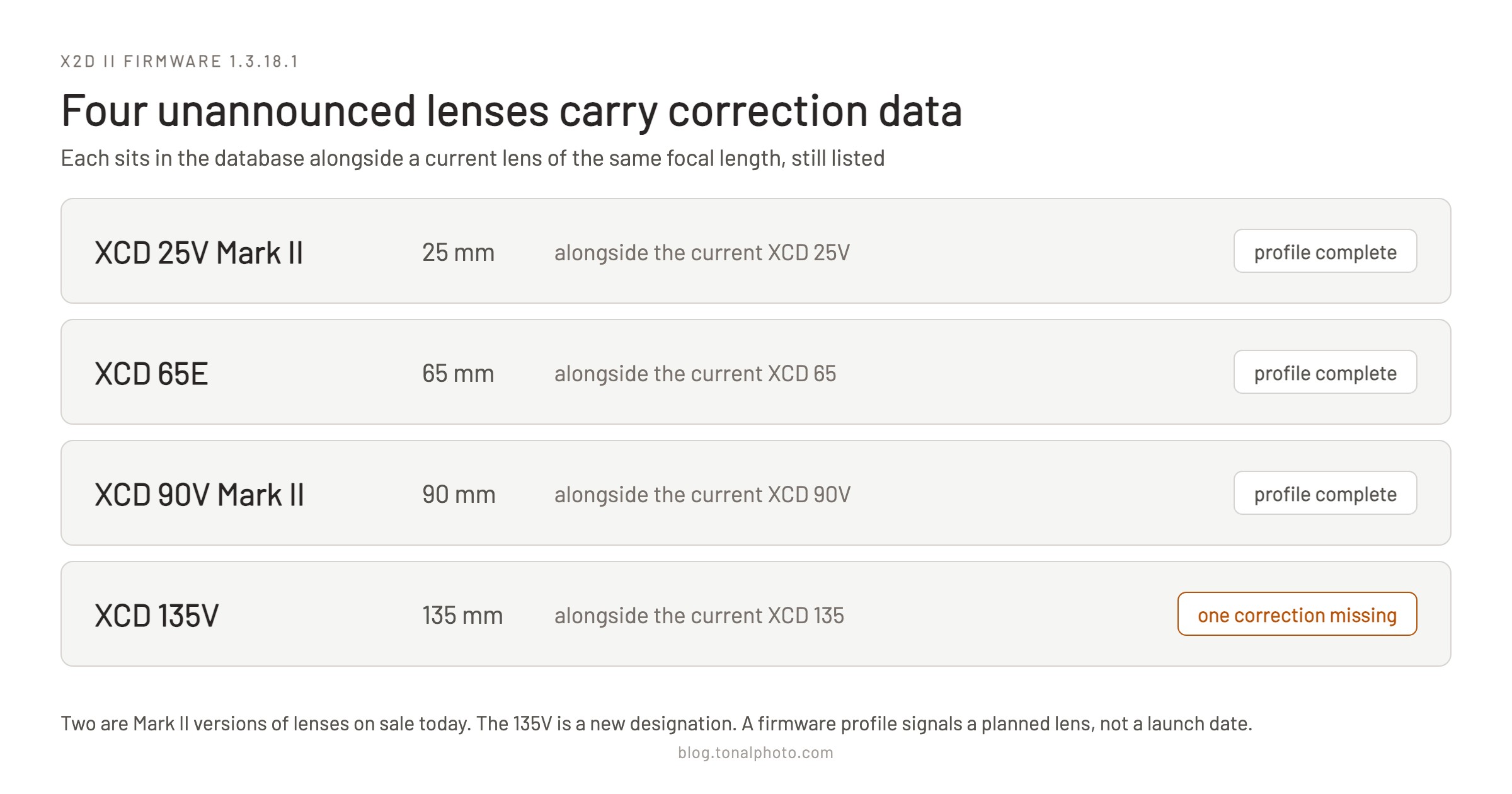
Image | Tonal Photo (firmware data chart)
65E / 135V / 25V II / 90V II
XCD 65E, faster than the current fastest XCD 80 f/1.9
How they were found
Every X System body carries a lens-correction database in its firmware, holding distortion, vignetting, color and focus calibration data for each lens. Comparing firmware versions turned up four unannounced entries: the 65E had been sitting under an older ID, while the 25V II, 90V II and 135V were added in version 1.3.16.1. This is not a leak; the data ships in the same firmware file every owner can download.
The four lenses in outline
The 65E’s vignetting table starts at f/1.7, which reads as a maximum aperture of f/1.7, a third of a stop faster than the XCD 80 f/1.9, with 0.56 m close focus; it would also be the first prime with the E badge. The 135V’s table starts at f/2.5 (the current 135 starts at f/2.8), close focus improves to 0.85 m, and the firmware labels a 1.8x converter pairing at about 233 mm. Both Mark IIs match the current lenses on focal length and close focus and start at the same f/2.5, but their autofocus scan-speed settings are higher, so the difference may be focusing performance.
How finished, and when
Three profiles, the 65E and both Mark IIs, are complete across all five correction types and share a February 2026 calibration batch. The 135V is missing one correction type (blue-corner shading) and its data is dated May, clearly a step behind. A complete profile usually means the optical design is final, but firmware says nothing about launch dates or prices: the 65E has been listed since September 2025 and is still unannounced more than a year later.
Highlights
The signal comes from Hasselblad’s own firmware, stronger than most rumors; the 65E f/1.7 could be the fastest X prime; two Mark IIs surface for the first time.
Shortcomings
Unconfirmed by Hasselblad, names and specs can change; launch timing is completely unknown; the Mark IIs’ optical changes cannot be read from the data.
Best for
X2D II and X System owners; anyone about to buy the current 25V, 90V or 135; medium-format watchers.
Our take
Firmware does not lie. It just does not tell time.
The weight of this story is its evidence level: not supply-chain whispers, but calibration data Hasselblad itself ships in public firmware. Every XCD lens ever released sits in that database, and a complete correction profile usually means the optical design is done. For X System owners, the existence of these four lenses is close to certain.
But firmware proves work in progress, not a launch date, and the 65E’s year-long wait is the reminder. The one practical takeaway: if you are about to buy the current XCD 135, 90V or 25V, waiting a little costs nothing. Everyone else can file this as a roadmap and keep shooting.
ZEISS at Camerimage: three cine lens families, tested by eye
Industry news, compiled from ZEISS and 4rfv, Oct 29, 2026
Cine lenses are usually judged from spec sheets. ZEISS brought the Aatma, Panoptes 65 and Horizon families to the Camerimage festival in Poland for hands-on shooting. The Lens Experience sessions, November 9 to 13, take just 10 people each to compare bokeh and flare directly.
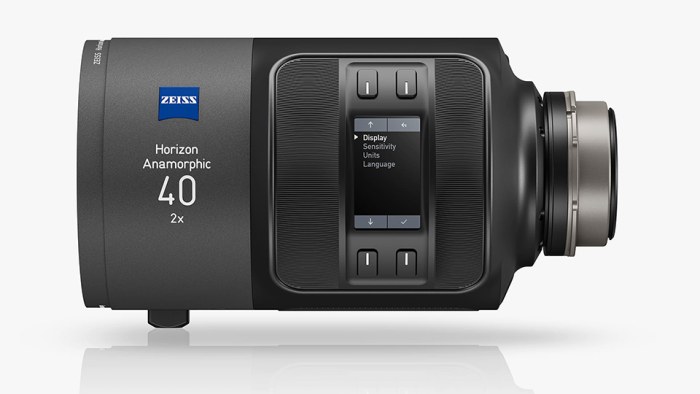
Image: ZEISS (via B&H Explora)
Toruń, CKK Jordanki
Nov 9–13, twice daily
What happened
ZEISS is showing its latest cine lenses at Camerimage 2026: Aatma, Panoptes 65, Horizon Anamorphic and Nano Primes. On November 10, the ‘Anamorphics. Reimagined.’ seminar covers the Horizon design philosophy and its Look Sets.
Three families
Aatma is a set of nine full-frame T1.5 primes (18–135mm) with a vintage rendering. Panoptes 65 is built for 65mm-format cameras: ten T2.2 lenses with a 59.9mm image circle covering cameras such as the ALEXA 265. Horizon is a full-frame 2x anamorphic line with built-in motors and swappable rear groups to adjust the image character.
Why it matters
The Lens Experience is not a product launch: the three families shoot the same set in rotation, so cinematographers decide by eye which character fits their film. For general readers it is also a signal: competition in cine lenses has moved from sharpness to selectable image character, and to how well lenses integrate with the post-production workflow.
Highlights
Three families compared side by side on the same set; proper sets and lighting, not just handling boxes; a seminar dedicated to the Look Sets concept.
Drawbacks
The event is in Poland, a high bar for most readers; session places are limited and need booking; cine lenses sit far from stills photography.
Best for
Cinematographers and directors of photography; crews considering ZEISS cine rentals; anyone curious about anamorphic lenses.
Editor’s Take
Cine lenses now compete on character, not sharpness.
On the surface this is a trade-show preview; underneath it is ZEISS making a product statement. Aatma sells vintage character, Panoptes 65 sells large-format coverage, Horizon sells swappable looks. Putting all three on one festival floor for people to shoot in turn says it plainly: spec sheets cannot rank these lenses, eyes can. For cine lenses, that is the right way to sell.
For most of our readers Camerimage is far away and cine lenses are expensive, so the value here is the trend line. When even ZEISS puts image character ahead of sharpness, the vintage rendering and softer looks in stills lenses over recent years stop looking like a coincidence. You may never buy a Panoptes 65, but this is the compass for reading lens design over the next few years.
More headlines
Camera and lens news beyond the main stories. Headlines only, click through to the source.
Share this story

-
You actually make it seem so easy with your presentation but I find this matter to be really something which I think I would never understand. It seems too complex and very broad for me. I’m looking forward for your next post, I’ll try to get the hang of it!